

Consumer medicine information

Azithromycin-WGR 500 mg Tablets

Azithromycin

BRAND INFORMATION

Brand name

Azithromycin-WGR

Active ingredient

Azithromycin

Schedule

S4

1. Why am I taking AZITHROMYCIN-WGR?


AZITHROMYCIN-WGR contains the active ingredient azithromycin dihydrate. AZITHROMYCIN-WGR is used to treat infections in different parts of the body caused by bacteria, such as chlamydia. Azithromycin belongs to a group of medicines called macrolide antibiotics.
For more information, see Section 1. Why am I taking AZITHROMYCIN-WGR? in the full CMI.

2. What should I know before I take AZITHROMYCIN-WGR?


Do not use if you have ever had an allergic reaction to AZITHROMYCIN-WGR or any of the ingredients listed at the end of the CMI.
Talk to your doctor if you have any other medical conditions, take any other medicines, or are pregnant or plan to become pregnant or are breastfeeding.
For more information, see Section 2. What should I know before I take AZITHROMYCIN-WGR? in the full CMI.

3. What if I am taking other medicines?


Some medicines may interfere with AZITHROMYCIN-WGR and affect how it works.
A list of these medicines is in Section 3. What if I am taking other medicines? in the full CMI.

4. How do I take AZITHROMYCIN-WGR?

  • Your doctor will tell you how much of this medicine you should take, depending on your condition and whether you are taking any other medicines.
  • The usual dose to treat chlamydia is two 500 mg tablets taken as a single dose. For other infections azithromycin is usually taken once a day. Sometimes the dose is taken once a week. Your doctor will decide the right dose for you.

More instructions can be found in Section 4. How do I take AZITHROMYCIN-WGR? in the full CMI.

5. What should I know while taking AZITHROMYCIN-WGR?

Things you should do
  • Remind any doctor, dentist or pharmacist you visit that you are taking AZITHROMYCIN-WGR.
  • If you become pregnant while taking AZITHROMYCIN-WGR, tell your doctor immediately.
  • If your infection does not improve within a few days, or if your symptoms become worse, tell your doctor.
  • If you get severe diarrhoea, tell your doctor immediately. Do this even if it occurs several weeks after you have stopped taking AZITHROMYCIN-WGR.
  • If you get a sore, white mouth or tongue while taking or soon after stopping AZITHROMYCIN-WGR, tell your doctor. Also tell your doctor if you get vaginal itching or discharge.
  • Protect your skin when you are in the sun, especially between 10am and 3pm.
Things you should not do
  • Do not stop taking AZITHROMYCIN-WGR, or change the dosage without first checking with your doctor.
  • If you do not complete the full course, all the organisms causing your infection may not be killed.
Driving or using machines
  • This medicine is not expected to affect your ability to drive a car or operate machinery.
Looking after your medicine
  • Keep your medicine in a cool dry place where the temperature stays below 25°C.
  • Do not store your medicine, or any other medicine, in the bathroom or near a sink. Do not leave it on a window sill or in the car.

For more information, see Section 5. What should I know while taking AZITHROMYCIN-WGR? in the full CMI.

6. Are there any side effects?


There are a number of side effects associated with AZITHROMYCIN-WGR. It is important to be aware of them so that you can identify any symptoms if they occur. For more information, including what to do if you have any side effects, see Section 6. Are there any side effects? in the full CMI.

BRAND INFORMATION

Brand name

Azithromycin-WGR

Active ingredient

Azithromycin

Schedule

S4

1 Name of Medicine

Azithromycin dihydrate.

2 Qualitative and Quantitative Composition

Each tablet contains 500 mg azithromycin (as dihydrate).
Excipients with known effect: Contains lactose.
For the full list of excipients see Section 6.1 List of Excipients.

3 Pharmaceutical Form

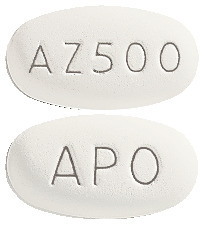
White, oval, biconvex film coated tablets engraved "APO" on one side and "AZ500" on the other side.

4 Clinical Particulars

4.9 Overdose

Symptoms. Most adverse events experienced in higher than recommended doses are similar in type and may be more frequent than those seen at normal doses. The incidence of tinnitus and ototoxicity is more frequent in overdosage than at normal doses.
Treatment. In the event of overdosage, general symptomatic and supportive measures are indicated as required.
As with many cationic amphiphilic drugs, phospholipidosis has been observed in some tissues of mice, rats and dogs given multiple doses of azithromycin. It has been demonstrated in numerous organ systems in dogs administered doses which, based on pharmacokinetics, are as low as 2-3 times greater than the recommended human dose and in rats at doses comparable to the human dose. This effect is reversible after cessation of azithromycin treatment. The significance of these findings for humans with overdose of azithromycin is unknown.
For information on the management of overdose, contact the Poisons Information Centre on 13 11 26 (Australia).

5 Pharmacological Properties

5.3 Preclinical Safety Data

Genotoxicity. Azithromycin showed no genotoxic potential in a range of standard laboratory tests for gene mutations and chromosomal damage.
Carcinogenicity. No studies have been done to determine the carcinogenic potential of azithromycin in animals.

6 Pharmaceutical Particulars

6.7 Physicochemical Properties

Azithromycin dihydrate is a white crystalline powder practically insoluble in water, freely soluble in anhydrous ethanol and in methylene chloride.
pKa1 - 8.8 (exocyclic tertiary amine).
pKa2 - 8.1 (endocyclic tertiary amine).
Partition Coefficient Log P (Hydrophobicity) 4.02.
Azithromycin is the first of a new class of antibiotics designated chemically as azalides, a subclass of macrolides, available for oral administration. Azithromycin, chemically 9-deoxo-9a-aza-9a-methyl-9a-homoerythromycin A contains a methyl substituted nitrogen atom at position 9A of the lactone ring.
Chemical structure.
https://stagingapi.mims.com/au/public/v2/images/fullchemgif/CSAZIDIH.gif Chemical name: 9-deoxo-9a-aza-9a-methyl-9a-homoerythromycin A dihydrate.
Molecular formula: C38H72N2O12.2H2O.
Molecular weight: 785.0.
CAS number. 117772-70-0.

7 Medicine Schedule (Poisons Standard)

S4 - Prescription Only Medicine.

Summary Table of Changes

https://stagingapi.mims.com/au/public/v2/images/fulltablegif/AZIWGRST.gif