

Consumer medicine information

Dicloxacillin Viatris 250 mg Capsules

Dicloxacillin sodium

BRAND INFORMATION

Brand name

Dicloxacillin Viatris

Active ingredient

Dicloxacillin sodium

Schedule

S4


Consumer medicine information (CMI) leaflet

Please read this leaflet carefully before you start using Dicloxacillin Viatris 250 mg Capsules.

1. Why am I taking DICLOXACILLIN VIATRIS?


DICLOXACILLIN VIATRIS contains the active ingredient dicloxacillin. DICLOXACILLIN VIATRIS is used to treat infections in different parts of the body caused by bacteria.
For more information, see Section 1. Why am I taking DICLOXACILLIN VIATRIS? in the full CMI.

2. What should I know before I take DICLOXACILLIN VIATRIS?


Do not take if you have ever had an allergic reaction to dicloxacillin or any of the ingredients listed at the end of the CMI.
Talk to your doctor if you have any other medical conditions, take any other medicines, or are pregnant or plan to become pregnant or are breastfeeding.
For more information, see Section 2. What should I know before I take DICLOXACILLIN VIATRIS? in the full CMI.

3. What if I am taking other medicines?


Some medicines may interfere with DICLOXACILLIN VIATRIS and affect how it works.
A list of these medicines is in Section 3. What if I am taking other medicines? in the full CMI.

4. How do I take DICLOXACILLIN VIATRIS?

  • Your doctor will tell you how much DICLOXACILLIN VIATRIS you need to take each day.
  • For most infections, the usual dose for adults and children over 12 years is 250 mg to 500 mg every 6 hours.

More instructions can be found in Section 4. How do I take DICLOXACILLIN VIATRIS? in the full CMI.

5. What should I know while taking DICLOXACILLIN VIATRIS?

Things you should do
  • Remind any doctor, dentist or pharmacist you visit that you are taking DICLOXACILLIN VIATRIS.
  • If your symptoms of infection do not improve within a few days, or they become worse, tell your doctor.
  • If you get severe diarrhoea, even if it occurs several weeks after stopping DICLOXACILLIN VIATRIS, tell your doctor or pharmacist immediately.
  • If you develop a yellow discolouration of the skin or eyes, or your stools become pale and you feel unwell, tell your doctor immediately.
Things you should not do
  • Do not stop taking DICLOXACILLIN VIATRIS even if you feel better after a few days, unless advised to by your doctor.
  • Do not use DICLOXACILLIN VIATRIS to treat any other conditions unless advised to by your doctor.
  • Do not give DICLOXACILLIN VIATRIS to anyone else, even if their symptoms seem similar to yours.
Looking after your medicine
  • Keep your capsules in the bottle until it is time to take them.
  • Keep DICLOXACILLIN VIATRIS in a cool dry place below 25°C.
  • Keep your medicine where children cannot reach it.

For more information, see Section 5. What should I know while taking DICLOXACILLIN VIATRIS? in the full CMI.

6. Are there any side effects?


Less serious side effects include nausea, vomiting, stomach upset, wind, loose stools, oral thrush or vaginal thrush.
Serious side effects include watery or severe diarrhoea which may also be bloody, blood in urine, excess protein in urine, severe stomach cramps, yellowing of the skin or eyes (jaundice), pale stools, kidney problems, any type of skin rash, itching or hives, swelling of the face, lips, mouth, throat or other parts of the body, shortness of breath, wheezing or difficulty breathing.
This is not a complete list of side effects.
For more information, including what to do if you have any side effects, see Section 6. Are there any side effects? in the full CMI.

BRAND INFORMATION

Brand name

Dicloxacillin Viatris

Active ingredient

Dicloxacillin sodium

Schedule

S4


1 Name of Medicine

Dicloxacillin (as dicloxacillin sodium).

2 Qualitative and Quantitative Composition

Each capsule contains dicloxacillin sodium equivalent to 250 mg or 500 mg dicloxacillin as the active ingredient.
Excipients with known effect in Dicloxacillin Viatris 250 mg capsules. Sulfites and 21.2 mg of sodium per dose.
Excipients with known effect in Dicloxacillin Viatris 500 mg capsules. Sulfites and 42.5 mg of sodium per dose.
For the full list of excipients, see Section 6.1 List of Excipients.

3 Pharmaceutical Form

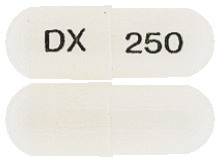
Dicloxacillin Viatris 250. Dicloxacillin 250 mg capsule: Size 2 capsule with white opaque body and cap, printed 'DX' on the cap and '250' on the body in black.
Dicloxacillin Viatris 500. Dicloxacillin 500 mg capsule: Size 0 capsule with white opaque body and cap, printed 'DX' on the cap and '500' on the body in black.

4 Clinical Particulars

4.9 Overdose

Treatment of dicloxacillin overdosage should be symptomatic and supportive. There is no specific antidote. Dicloxacillin is not removed by haemodialysis or peritoneal dialysis.
For information on the management of overdose, contact the Poisons Information Centre on 13 11 26 (Australia).

5 Pharmacological Properties

5.3 Preclinical Safety Data

Genotoxicity. No data available.
Carcinogenicity. No data available.

6 Pharmaceutical Particulars

6.7 Physicochemical Properties

Dicloxacillin sodium is an antibiotic and a member of the isoxazolyl penicillins. Dicloxacillin sodium is a white or almost white, crystalline powder. It is hygroscopic, freely soluble in water, soluble in alcohol and in methanol.
Chemical structure. Chemical name: (6R)-6-[3-(2, 6-dichlorophenyl)-5-methylisoxazole-4-carboxamido]-penicillanate.
Structural formula:
https://stagingapi.mims.com/au/public/v2/images/fullchemgif/CSDICLOX.gif Molecular Formula: C19H16Cl2N3NaO5S.H2O. Molecular Weight: 510.3.
CAS number. 13412-64-1.

7 Medicine Schedule (Poisons Standard)

S4 (Prescription Only Medicine).

Summary Table of Changes

https://stagingapi.mims.com/au/public/v2/images/fulltablegif/DICVIAST.gif