1 Name of Medicine
Finasteride.
2 Qualitative and Quantitative Composition
Proscar contains 5 mg of finasteride as the active ingredient.
List of excipients with known effect. Lactose.
For the full list of excipients, see Section 6.1 List of Excipients.
3 Pharmaceutical Form
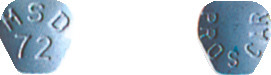
Proscar 5 mg. A blue apple shaped film coated tablet engraved MSD72 one side, Proscar on the other side.
4 Clinical Particulars
4.9 Overdose
Patients have received single doses of Proscar up to 400 mg and multiple doses of Proscar up to 80 mg/day for three months without adverse effects.
No specific treatment of overdosage with Proscar is recommended. General supportive care should be given. For information on the management of overdose, contact the Poison Information Centre on 131126 (Australia).
5 Pharmacological Properties
5.3 Preclinical Safety Data
Genotoxicity. No evidence of mutagenicity was observed in an in vitro bacterial mutagenesis assay, a mammalian cell mutagenesis assay, or in an in vitro alkaline elution assay. In an in vitro chromosome aberration assay, when Chinese hamster ovary cells were treated with high concentrations (450-550 micromol) of finasteride, there was a slight increase in chromosome aberrations. These concentrations correspond to 4000-5000 times the peak plasma levels in man given a total dose of 5 mg. Further, the concentrations (450-550 micromol) used in the in vitro studies are not achievable in a biological system. In an in vivo chromosome aberration assay in mice, no treatment related increases in chromosome aberration were observed with finasteride at the maximum tolerated dose (250 mg/kg/day).
Carcinogenicity. In a 24 month carcinogenicity study in rats there was an increase in the incidence of thyroid follicular adenomas in male rats receiving 160 mg/kg/day finasteride (statistically significant trend test). This dose produced a systemic exposure in rats 111 times that observed in humans at the recommended dose (based on AUC(0-24 hrs) values). The effect of finasteride on the thyroid in rats appears to be due to an increased rate of thyroxine clearance and not a direct effect on the drug. These observations seen in the rat are thought not relevant to man.
In a 19 month carcinogenicity study in mice, a statistically significant (p ≤ 0.05) increase in the incidence of testicular Leydig cell adenoma was observed at a dose of 250 mg/kg/day; no adenomas were seen in mice given 2.5 or 25 mg/kg/day.
In mice at a dose of 25 mg/kg/day and in rats at a dose of ≥ 40 mg/kg/day, an increase in the incidence of Leydig cell hyperplasia was observed. A positive correlation between the proliferative changes in the Leydig cell and the increase in serum luteinizing hormone (LH) levels (2-3 fold above control) has been demonstrated in both rodent species treated with high doses of finasteride. This suggests the Leydig cell changes are secondary to elevated serum LH levels and not due to a direct effect of finasteride.
No drug related Leydig cell changes were seen in either rats or dogs treated with finasteride for one year at doses of 20 mg/kg/day and 45 mg/kg/day respectively, or in mice treated for 19 months at a dose of 2.5 mg/kg/day.
6 Pharmaceutical Particulars
6.7 Physicochemical Properties
Finasteride is a white, crystalline solid. It is freely soluble in chloroform and in lower alcohol solvents, but is practically insoluble in water.
Tablets Proscar contain finasteride, which is described chemically as: N-(1,1-dimethylethyl)-3-oxo-4-aza-5α-androst-1-ene-17β-carboxamide.
The empirical formula is C23H36N2O2 and the molecular weight is 372.55.
Chemical structure. The structural formula is:
https://stagingapi.mims.com/au/public/v2/images/fullchemgif/CSFINAST.gif CAS number. 98319-26-7.
7 Medicine Schedule (Poisons Standard)
Prescription Only Medicine (S4).
Summary Table of Changes
https://stagingapi.mims.com/au/public/v2/images/fulltablegif/PROSCAST.gif